


You didn’t build a business just to become an employee trapped inside its engine.
Yet, for many founders, there comes a point where the drive that sparked the venture turns into a silent, relentless grind. It starts quietly: an unread email inbox that feels like an impending crisis, a subtle dread before standard status meetings, or a sense of emotional numbness when closing a major contract that should have been celebrated.
When you carry the ultimate responsibility for payroll, strategic direction, and team livelihoods, traditional burnout advice (like “take a vacation” or “download a meditation app”) feels dismissive. What you are experiencing isn’t just fatigue; it is an executive-level strain that demands a clinically grounded, operationally sound response.
Key Takeaways for Founders
- Burnout is neurological, not motivational: Entrepreneurial burnout is chronic neuro-autonomic exhaustion, distinct from the temporary sprints of high-performative stress.
- Internal strain becomes operational friction: Clinical symptoms such as executive dysfunction and emotional blunting directly trigger P&L avoidance, decision bottlenecks, and team churn.
- Generic self-care fails high-achievers: Disconnecting without operational safeguards increases anxiety; true recovery requires structural containment, not enterprise abandonment.
- Recovery maintains business continuity: The Continuity Recovery Protocol stabilizes your nervous system and decouples personal identity from metrics while keeping the enterprise running.
- Clinical support must match leadership weight: Specialized care isolates unconscious psychological drivers from everyday business bottlenecks.
What Is Entrepreneurial Burnout vs. High-Performative Stress?
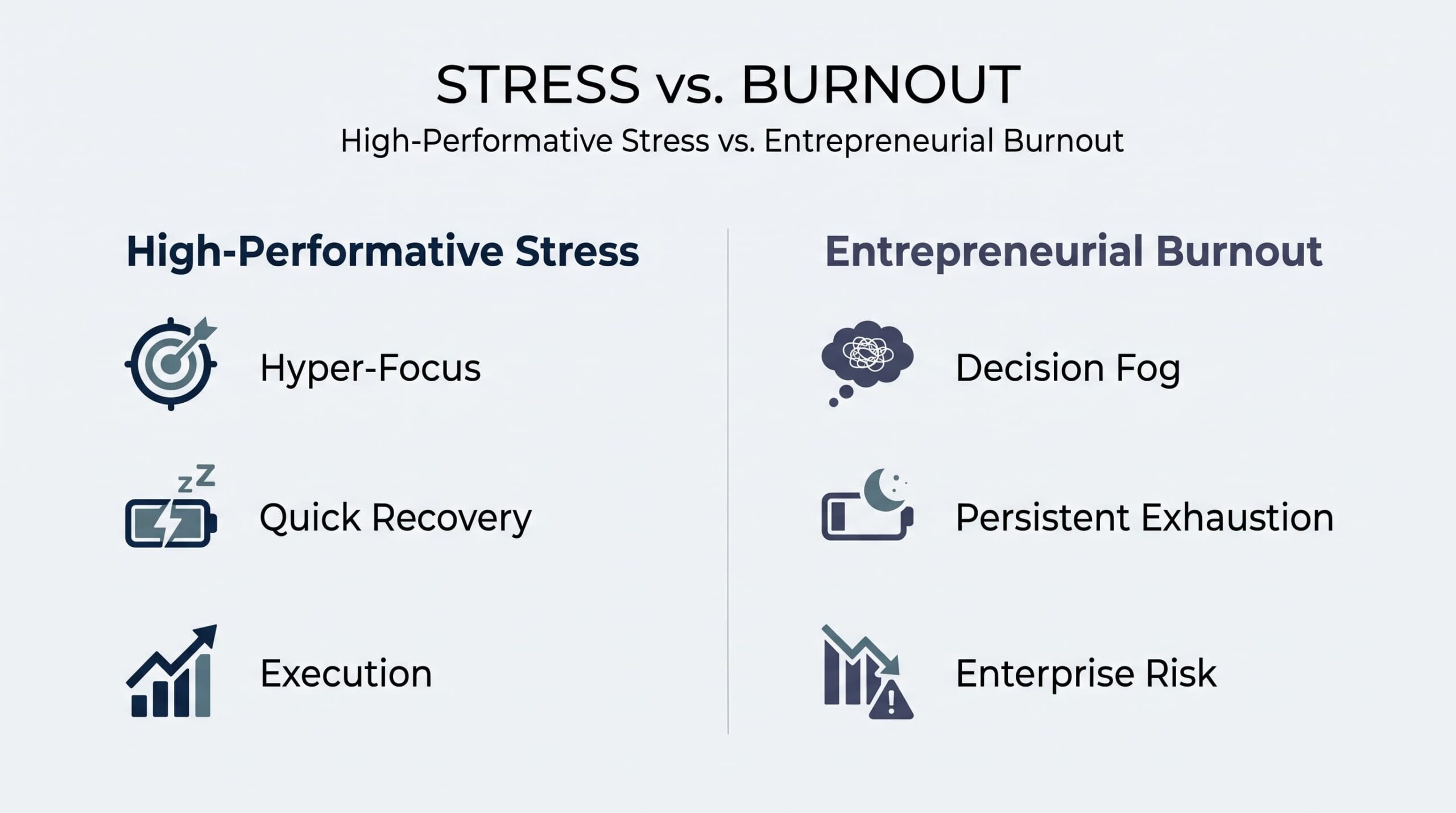
Entrepreneurial burnout is a state of chronic neuro-autonomic exhaustion, clinical detachment, and degraded executive efficacy caused by prolonged business responsibility. Unlike high-performative stress, which is temporary and driven by operational sprints, burnout depletes cognitive reserves, distorts risk tolerance, and erodes strategic vision, threatening both the leader’s health and enterprise stability.
The World Health Organization classifies burnout as an occupational phenomenon resulting from chronic workplace stress that has not been successfully managed, characterized by exhaustion, mental distance or cynicism toward one’s work, and reduced professional efficacy.
In my dual career as a Licensed Professional Counselor (LPC) and an executive managing large healthcare operations, I’ve seen this distinction blurred constantly. High performers often wear their stress like armor, assuming that running on adrenaline is simply the price of admission.
It isn’t.
Founders are not a low-risk population. A study of 242 entrepreneurs published in Small Business Economics found that entrepreneurs reported significantly higher lifetime rates of depression, ADHD, substance use and bipolar spectrum conditions than a comparison sample, with 49% reporting at least one lifetime mental health condition. The traits that make people good at building companies are not neutral, and they interact with sustained operational pressure in specific ways.
Stress is an acute response to external demand. When you are pitching investors, negotiating vendor contracts, or launching a new product line, your sympathetic nervous system activates. Cortisol and adrenaline spike to sharpen your focus, speed up your reactions, and push you through the finish line.
Crucially, once that sprint ends, your nervous system resets.
Burnout is systemic autonomic depletion. It occurs when the pressure never lets up, and your brain’s adaptive survival systems remain permanently engaged. Over time, that chronic activation suppresses immune function and impairs the prefrontal cortex: the part of your brain responsible for nuanced, long-term strategic decision-making. Chronic stress exposure has been shown to weaken the very connectivity in prefrontal circuits that higher-order planning depends on.
| Metric | High-Performative Stress | Entrepreneurial Burnout |
| Cognitive State | Hyper-focused, energized, urgent | Fragmented, fogged, indecisive |
| Emotional Tone | Anxious, driven, reactive | Numb, cynical, detached |
| Response to Rest | Restored by a weekend off | Exhaustion remains after extended time away |
| Impact on Business | Accelerates short-term execution | Stalls growth; causes decision paralysis |
| View of the Future | Challenging but solvable | Bleak; recurring escape fantasies |
If you are merely stressed, taking a long weekend helps you bounce back. If you are experiencing entrepreneurial burnout in Atlanta or running a demanding remote enterprise, a week on a beach does nothing because the underlying psychological drivers, paired with the sheer operational weight, are right there waiting the moment you check Slack.
The Executive Burnout Self-Assessment Matrix
To accurately diagnose your current state, we need to bridge the gap between clinical psychology and operational reality. Below is an executive self-assessment designed to measure how internal neuro-psychological strain manifests in your day-to-day leadership.
Review these five core domains honestly:
| Clinical Symptom | Internal Monologue | Business & Operational Impact |
| Executive Dysfunction | “I cannot face this P&L review, and I’m putting off critical hiring decisions.” | Bottlenecked workflows, missed revenue opportunities, and delayed operational execution. |
| Anhedonia & Emotional Blunting | “We hit our quarterly target, but I feel completely numb to the win.” | Loss of strategic vision, disengagement from client relationships, and uninspired team leadership. |
| Hypervigilance & Irritability | “Why can’t my leadership team resolve anything without my direct intervention?” | Micromanagement, snap reactions in meetings, executive churn, and cultural friction. |
| Severe Decision Fatigue | “Every minor operational choice feels like a high-stakes emergency.” | Chronic second-guessing, analysis paralysis, or impulsive, low-quality concessions. |
| Autonomic Dysregulation | “My body is physically exhausted, but my mind is racing at 3:00 AM.” | Fragmented sleep architecture, daytime fatigue, and reliance on stimulants to function. |
The emotional blunting in row two is not incidental. In Christina Maslach’s foundational model, cynicism and detachment are a core dimension of burnout in their own right, not merely a byproduct of exhaustion.
Scoring Your Self-Assessment
- 1–2 Indicators (Elevated Load): You are experiencing high-demand stress. Targeted operational adjustments and boundary reinforcement can bring you back into equilibrium.
- 3–4 Indicators (Active Executive Burnout): Your cognitive capacity and emotional reserves are compromised. Your business is already absorbing the friction of your internal state.
- 5 Indicators (Systemic Founder Crisis): You are operating in severe neuro-autonomic exhaustion. Without immediate clinical and structural intervention, both personal health and enterprise value face significant risk.
If you recognized your daily reality in three or more rows of this matrix, your burnout is actively eroding your company’s performance. Working with an experienced therapist for entrepreneurs can help you isolate cognitive fatigue from operational bottlenecks to build a structured, sustainable way forward. If you scored a five, schedule a confidential consultation rather than waiting for the next quarter to force the issue.
The 5 Hidden Operational Signs Your Business Is Suffering from Founder Burnout
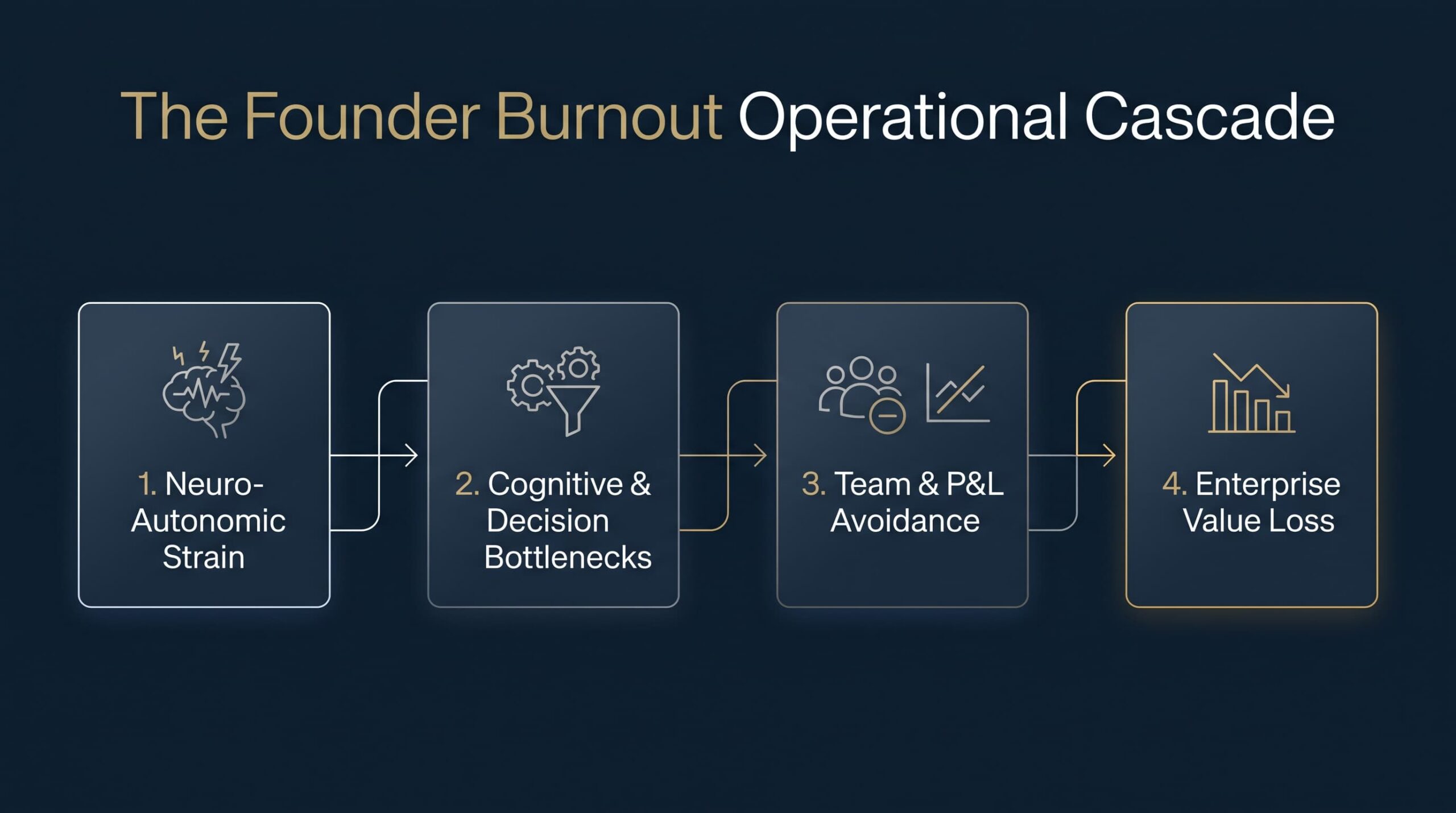
Burnout rarely stays confined to your personal life. When an entrepreneur’s nervous system is dysregulated, that strain cascades through the entire organization.
In my practice, founders often come to me thinking they have an operations problem, only to discover it is an unaddressed psychological bottleneck.
Founder Mental Strain ——> Cognitive Degradation ——> Operational Friction ——> Enterprise Value Loss
1. Bottlenecking Strategic Execution
When executive function declines, processing complex information becomes exhausting. You stop reviewing proposals, postpone key hires, and sit on contract approvals. Because you hold final sign-off authority, the entire enterprise slows to a crawl while waiting on your depleted mental bandwidth.
2. Loss of Client Empathy and Service Drift
Early in your business, solving client problems provided genuine fulfillment. Under chronic burnout, client interactions start feeling like intrusions. You may notice your patience thinning during onboarding, or you begin delegating critical account relationships without proper oversight just to create emotional distance.
3. P&L and Metric Avoidance
Financial clarity requires cognitive resilience. When burned out, founders often avoid reviewing spreadsheets, checking bank balances, or analyzing KPI dashboards. This isn’t laziness: it is an unconscious defense mechanism to avoid triggering acute panic. Unfortunately, ignoring financial indicators only increases downstream risk.
4. Boundary Erosion with Leadership Teams
Burnout distorts how you manage authority, swinging between two extremes:
- Impulsive Abdication: Dumping critical responsibilities onto unprepared staff without clear processes simply because you can no longer carry the mental load.
- Anxious Micromanagement: Clinging tightly to minor operational details out of an irrational fear that letting go will cause everything to collapse. This is the point where coaching quietly gives way to command.
5. Pre-Nostalgia and Escape Fantasies
A subtle but telltale sign of founder burnout is chronic “exit daydreaming.” You catch yourself researching distressed asset sales, wondering what a low-multiple acquisition would look like, or daydreaming about taking a mid-level corporate job just to have predictable hours. You are no longer building for long-term equity; you are looking for an exit hatch. When those fantasies start feeling like plans, career-change and life transition therapy is worth having alongside the clinical work.
Why Traditional “Self-Care” Advice Fails High-Achieving Founders
Telling a business owner who carries payroll for 30 families to “take two weeks completely off the grid” is clinically irresponsible.
When you are the owner, uncoupling from your business without proper structural safeguards doesn’t reduce anxiety; it amplifies it. You spend the entire “vacation” worrying about cash flow, operations, and client churn. That is acute anxiety doing exactly what it does under threat, not rest failing to work.
Traditional Advice: “Disconnect and rest.”
Founder Reality: Disconnection without systems breeds acute anxiety.
This is also why organization-level thinking matters. NIOSH’s occupational stress research consistently finds that job conditions themselves — workload, control, and role clarity — drive stress outcomes more reliably than individual coping capacity. For a founder, you are simultaneously the worker and the job condition.
The Burden of Payroll and Solitude
Before establishing Talk Forward Counseling, I spent over two decades in executive management, including serving as CEO of a public behavioral health agency overseeing 450 employees and an annual budget of $27 million.
I understand the weight of knowing that if you fail, people don’t just lose projects; they lose livelihoods.
You cannot share this fear with your staff because doing so damages organizational morale. You often cannot share it fully with your spouse because you want to protect your home from business anxiety. This isolation turns every operational obstacle into an internal crisis.
The Identity Fusion Dilemma
For most founders, the boundary between the “self” and the “enterprise” has dissolved:
- If the business has an exceptional month, you feel worthy, capable, and confident.
- If a major client churns or revenue dips, it feels like an indictment of your character and intelligence.
When your identity is completely fused with your enterprise, every normal market fluctuation feels like an existential threat. True recovery requires uncoupling your personal identity from daily business metrics so you can lead with objective clarity rather than emotional volatility.
The Continuity Recovery Protocol: Healing Burnout Without Abandoning Your Business
Recovery does not require shutting down your company, stepping down as CEO, or disappearing to an ashram. It requires implementing practical, evidence-based systems that protect your neurobiology while keeping the business moving forward.
Phase 1: Neuro-Autonomic Stabilization
Before you can fix company systems, you have to stabilize your baseline nervous system.
- Audit Your Cognitive Inputs: Stop checking operational channels (Slack, email, Stripe alerts) within the first 60 minutes of waking and the last 60 minutes before sleep. Constant early-morning cortisol spikes keep your nervous system in a permanent fight-or-flight state.
- Protect Somatic Recovery: Focus on basic biological baselines: restorative sleep architecture, adequate hydration, and moderate physical output. A depleted brain cannot execute complex strategic maneuvers.
- Implement Sensory Resets: When you notice acute anxiety rising during the workday, use physiological sighs (two quick inhales through the nose, one long exhale through the mouth) to mechanically down-regulate sympathetic arousal. A randomized controlled trial published in Cell Reports Medicine found that five minutes of daily cyclic sighing produced greater improvement in mood and greater reduction in respiratory rate than equivalent-duration mindfulness meditation.
Phase 2: Tactical Decision Containment
Decision fatigue is an operational drain. Protect your executive bandwidth by creating strict decision boundaries.
- Establish Decision Tiers: Categorize choices into Tier 1 (reversible, low-impact) and Tier 2 (irreversible, strategic). Require your leadership team to handle all Tier 1 decisions autonomously.
- Time-Box High-Stakes Thinking: Limit deep strategic work to your natural biological peak (usually a 90-minute morning window). Never make structural, financial, or personnel decisions after 4:00 PM when cognitive reserves are depleted.
- Batch Communication Windows: Consolidate email and operational check-ins into two dedicated 45-minute blocks per day rather than reacting to notifications continuously.
Phase 3: Identity Decoupling & Boundary Systems
You are an executive managing an asset; you are not the asset itself.
- Differentiate Role from Identity: Begin consciously viewing your role as Chief Executive as a functional job you perform, not the entirety of who you are. This creates the emotional distance required for sound judgment.
- Install Hard Stops: Choose a realistic time in the evening when operational engagement ceases completely. Boundaries are meaningless if they are constantly renegotiated under pressure.
- Reclaim Non-Work Mastery: Cultivate at least one domain outside your company where performance is irrelevant. You need outlets that engage your mind without demanding measurable business ROI.
Phase 4: Clinical Psychological Integration
Working with a licensed clinician who understands executive dynamics allows you to examine the unconscious drivers behind your work patterns. Engaging in specialized therapy for entrepreneurs combines cognitive behavioral restructuring with pragmatic leadership frameworks, teaching you to navigate high stakes without sacrificing internal peace. For founders whose primary presentation is chronic overload rather than identity fusion, stress management therapy for Marietta professionals may be the better entry point.
Recovery doesn’t require closing your doors, stepping down, or compromising revenue. It requires a clinical framework built specifically for the realities of leadership. Schedule a Confidential Phone Consultation with Bryan Stephens, LPC, MBA.
Frequently Asked Questions About Founder Burnout
Can you recover from entrepreneurial burnout while still running your business?
Yes. Recovery does not depend on full operational detachment; it depends on changing how you interact with the business. By establishing decision containment, restructuring cognitive habits, and seeking clinical support, founders can recover clarity and stamina while maintaining enterprise momentum.
How long does executive burnout recovery typically take?
In my clinical experience, business owners who commit to focused intervention and boundary restructuring often begin noticing meaningful improvements in cognitive clarity, sleep, and emotional regulation within 6 to 12 weeks. Deeper behavioral change and sustained autonomic recovery generally take longer, and timelines vary considerably depending on how long the strain has been running and what else is present. What to expect in your first counseling session covers how that process usually begins.
What is the difference between executive coaching and therapy for entrepreneurs?
Executive coaching focuses primarily on external strategy, leadership skills, and operational KPIs. Therapy for entrepreneurs, led by a licensed clinical professional, addresses the deeper psychological systems: chronic nervous system dysregulation, imposter syndrome, identity fusion, and cognitive distortions. It resolves the internal roots of burnout so that strategic coaching can actually stick. Our therapy FAQ answers the practical questions about scheduling, format, and what sessions involve.
About the Author
Bryan G. Stephens, LPC, MBA, NCC, CPCS, is the founder of Talk Forward Counseling in Marietta, Georgia. A Licensed Professional Counselor and former CEO who managed an annual behavioral health budget of $27M and 450 employees, Bryan served as President of the Licensed Professional Counselors Association of Georgia (LPCA) from 2021 to 2024. He specializes in a pragmatic, neuro-affirming Founder-to-Founder clinical approach that helps high-achieving business owners overcome burnout, stabilize autonomic stress, and lead with clarity. Learn more about Bryan’s clinical background and executive career.
Clinical & Medical Disclaimer
This article is provided for educational and informational purposes only and does not constitute medical, psychiatric, or psychological advice, diagnosis, or treatment. Reading this content does not create a therapist-client relationship. If you are experiencing severe psychological distress, chronic panic, or persistent physical symptoms, please consult a qualified healthcare provider or licensed mental health professional.
Crisis Support & Emergency Directives
If you are experiencing an acute mental health crisis, suicidal thoughts, or overwhelming distress, immediate confidential support is available 24/7:
- Suicide & Crisis Lifeline: Call or text 988 (Available nationwide across the US)
- Crisis Text Line: Text HOME to 741741 to connect with a crisis counselor
- Emergency Medical Services: Dial 911 or go to your nearest emergency room