


The Bottom Line (Key Takeaways):
- Coverage Varies by Network Status: Most Georgia health plans cover mental health care, but your real out-of-pocket cost depends on deductibles, copays, and out-of-network benefits.
- In-Network vs. Out-of-Network: In-network copays typically run $20–$50 per session. Out-of-network sessions run $150–$250+ upfront, though you can often recover 50%–80% via Superbills.
- The Diagnostic Requirement: Insurance claims require a formal DSM-5 diagnosis that enters your permanent medical record.
- Self-Pay Protects Privacy: Paying out-of-pocket bypasses third-party audits and gives you full control over frequency and focus.
When business leaders and high-performing professionals first reach out to my practice, their real question isn’t just “Can I get help?” It’s: How does paying for therapy actually work, and how do I protect my time, privacy, and finances in Georgia?
This guide focuses on how insurance, sliding scale fees, and reimbursement change what you actually pay — not flat per-session rates. If you’re looking for typical Georgia therapy pricing instead, see our full therapy cost breakdown.
How Does Therapy Insurance Coverage Work in Georgia?
Health insurance plans in Georgia generally include mental health benefits under federal parity laws and state mandates, meaning insurers must offer mental health coverage comparable to medical and surgical care.
But “covered” doesn’t mean “fully paid.” Your actual responsibility depends on whether your provider is in-network, out-of-network, or self-pay.
Self-Pay vs. In-Network vs. Out-of-Network: What’s the Real Cost?
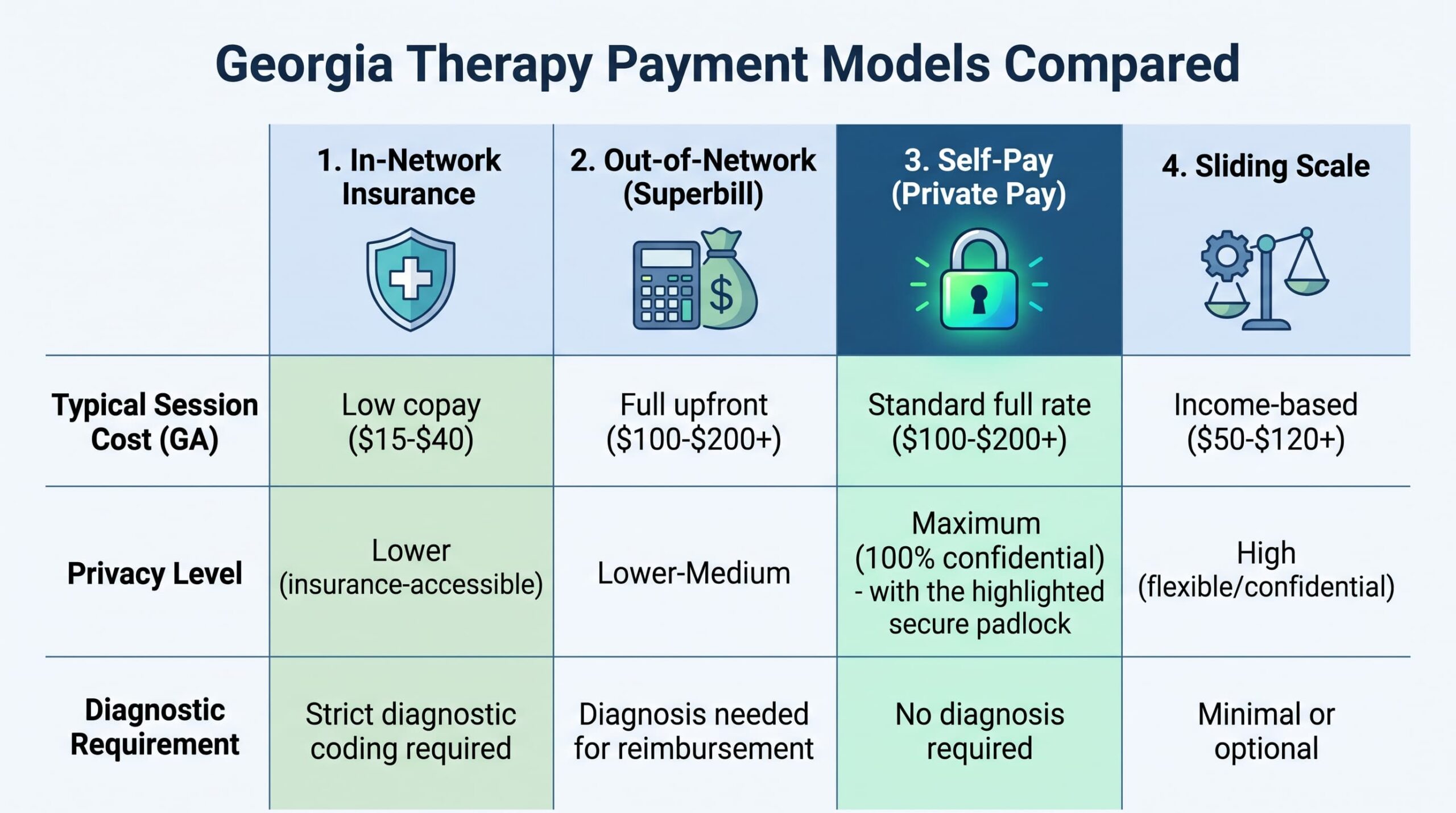
| Payment Model | Typical Cost per Session (GA) | Diagnostic Requirement | Medical Record Entry (MIB) | Flexibility |
| In-Network Insurance | $20–$50 (copay after deductible) | Mandatory (DSM-5) | Yes (permanently logged) | Restricted by insurer approval |
| Out-of-Network (Superbill) | $150–$250+ upfront ($40–$100 net after reimbursement) | Mandatory (DSM-5) | Yes (logged at claim submission) | Flexible provider choice |
| Self-Pay (Private Pay) | $150–$250+ | None required | No (100% confidential) | Complete control |
| Sliding Scale | $50–$120 (income-based) | Varies by practice | Depends on practice funding | Limited by open slots |
Insurance carriers view therapy through a strict medical lens: to approve a claim, they require proof of medical necessity – an official psychiatric diagnosis on your record.
How Do Out-of-Network Superbills Work in Georgia?
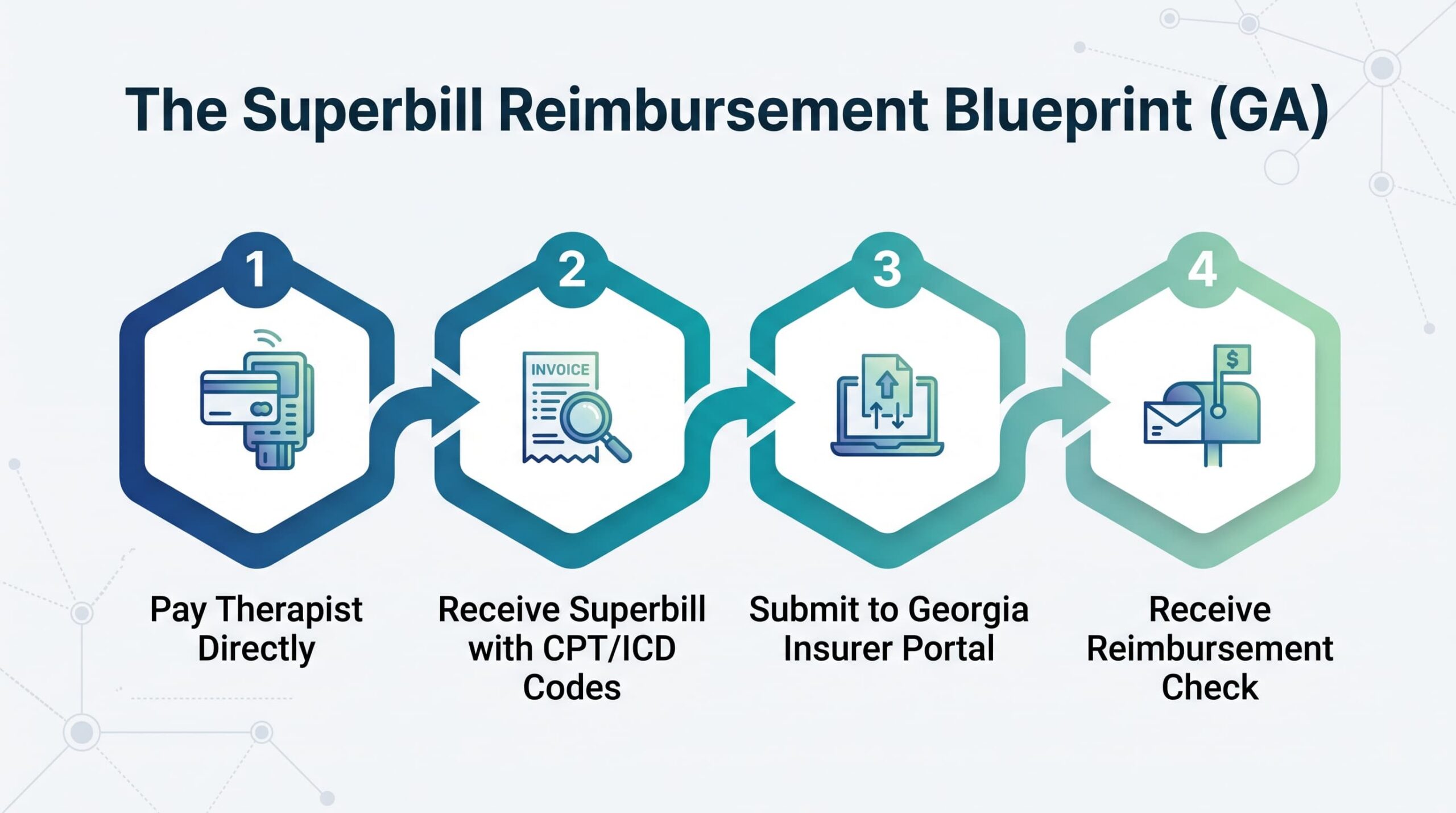
Many experienced Georgia clinicians choose not to join insurance panels, but you can still use out-of-network benefits to offset the cost. A Superbill is an itemized receipt containing the clinical and billing codes your insurer needs to process reimbursement. You pay your therapist directly, submit the Superbill, and receive a check in the mail.
Submitting a Superbill in four steps:
- Pay upfront using a card, HSA, or FSA.
- Receive your Superbill — a statement listing dates, fees, procedure codes (such as CPT code 90837 for a 53+ minute session), and diagnosis codes (ICD-10).
- Upload it to your insurer’s portal under “Out-of-Network Claims.”
- Collect reimbursement — once you meet your deductible, insurers typically cover 50%–80% of their allowed rate.
Not sure which option fits your situation? Schedule a confidential 15-minute phone consultation.
Reimbursement math example: A $200 session, with a $130 insurer-allowed rate and 70% coinsurance, nets a $91 reimbursement check — a real out-of-pocket cost of $109, not $200.
Why Do Many High-Level Therapists in Georgia Operate as Self-Pay?
Self-pay eliminates third-party medical oversight and keeps treatment off permanent insurance records. Having spent over 30 years in behavioral health — as both a Licensed Professional Counselor and an executive managing healthcare systems with 450+ employees and $27M budgets — I’ve seen firsthand how insurance structures dictate clinical decisions, favoring high volume and short-term stabilization over the sustained work executives and business owners often need.
Does Using Insurance Create a Permanent Mental Health Record?
Yes. Insurers require a formal DSM-5 diagnosis — Major Depressive Disorder, Generalized Anxiety Disorder, and so on — to pay a claim. That diagnosis enters your permanent medical history and gets logged in databases like the Medical Information Bureau (MIB), which can surface later during life or disability insurance underwriting, or trigger insurer audits of the clinical notes your therapist takes to verify “medical necessity.” While this is true for all medical appointments, clinical notes often have much more personal information than a regular doctor’s visit. For clients in government-adjacent or federal-contract roles, it can also affect security clearance disclosure — routine counseling for marital, family, or grief issues is exempt from SF-86 reporting, but an insurance-generated diagnosis removes that ambiguity.
For high-performing individuals, self-pay isn’t just an expense — it’s a strategic investment in privacy and control, keeping your work between you and your counselor.
It is important to note if you use a superbill for reimbursement, all of the above still applies.
What Is a Sliding Scale Fee, and Who Qualifies in Georgia?
A sliding scale fee adjusts your session rate to household income, keeping counseling accessible during career shifts, financial setbacks, or coverage gaps. Practices typically verify income with a pay stub or tax document, then apply tiered rates — a $180 standard fee might drop to $60, $90, or $120 depending on your bracket. Most private practices reserve only 10%–15% of weekly slots for sliding-scale clients, so ask about availability at your initial consultation.
Frequently Asked Questions
Can I use my HSA or FSA for therapy in Georgia? Yes. Pre-tax funds from an HSA or FSA cover self-pay fees, out-of-network rates, copays, and deductibles for licensed psychotherapy.
How do I check my out-of-network deductible? Call the number on your insurance card and ask: your deductible for outpatient mental health (CPT code 90837), how much you’ve met, and the maximum allowed amount for your zip code.
What is a Good Faith Estimate? Under the No Surprises Act, providers must give self-pay clients a written estimate of expected fees before care starts.
Will my employer find out if I use company-provided health insurance for therapy?
Under HIPAA laws, your employer does not receive itemized details about your claims or diagnosis. However, the claim is processed through your corporate policy, generating an Explanation of Benefits (EOB) within your insurer’s portal and creating a diagnostic record with the insurance carrier.
What is the difference between CPT codes 90837 and 90834 on a Superbill?
CPT code 90837 covers a standard 53+ minute individual psychotherapy session, whereas CPT code 90834 covers a 45-minute session. Insurers calculate your reimbursement check based on the specific code billed, with 90837 carrying a higher allowed reimbursement rate.
Taking the Next Step
Financial logistics shouldn’t stand between you and the clarity you need to perform at your best. Whether you use out-of-network Superbills, self-pay privacy, or a sliding scale rate, the goal is steady progress on your own terms.
About the Author
Bryan G. Stephens, LPC, MBA is a Licensed Professional Counselor, Certified Professional Counselor Supervisor (CPCS), and former President of the Licensed Professional Counselors Association of Georgia. He specializes in founder burnout, executive stress management, and practical psychotherapy in Marietta, GA, and via telehealth statewide.
Ready for Structured, Practical Therapy Without Insurance Barriers?
Schedule Your Confidential Consultation Today — take the first step toward clear, grounded performance.
Disclaimer: The information provided in this article is for educational purposes only and does not constitute formal medical or psychological advice, diagnosis, or treatment. Always consult a qualified health provider regarding any mental health concerns.
If you are experiencing a mental health emergency or crisis, immediate help is available 24/7:
- Suicide & Crisis Lifeline: Call or text 988
- Crisis Text Line: Text HOME to 741741
- Emergency Services: Call 911 or visit your nearest emergency room.